In 2025, many SaaS marketers still believe that as long as their email list is “clean,” their campaigns will automatically land in the inbox. But there’s a quiet saboteur hiding inside those so-called clean lists — catch-all domains.
Most email verification tools flag these addresses as “unknown,” leaving up to 40% of your list in limbo. That means wasted sends, damaged sender reputation, and fewer real conversions.
In this blog, we’ll break down what catch-all domains actually are, why they silently drain your ROI, and how advanced solutions (like DataStreams.ai) can accurately determine which catch-alls are truly deliverable.
What is a Catch-All Domain (and Why Does It Matter)?
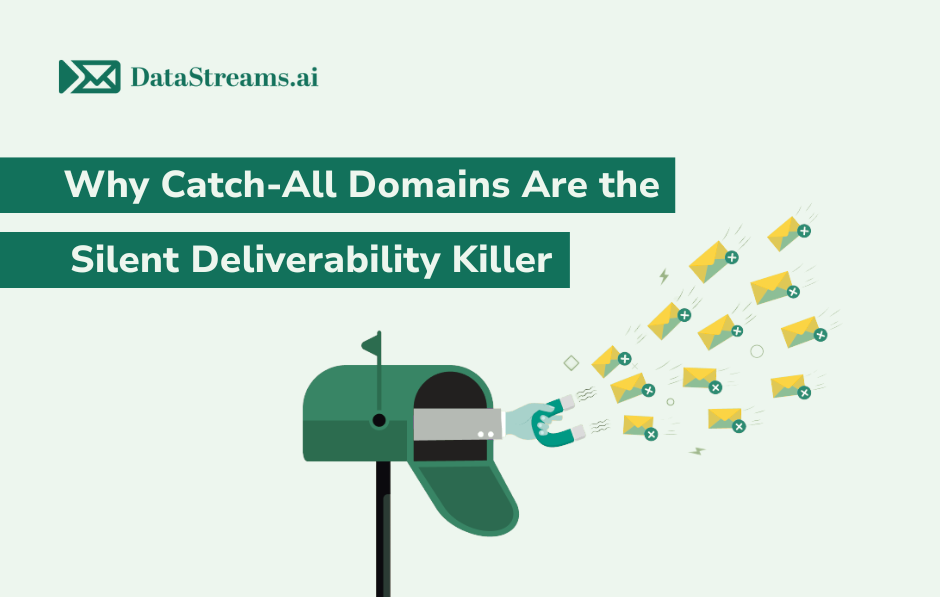
A catch-all domain is configured to accept all incoming emails, whether the specific inbox exists or not.
For example, if you send a message to randomname@company.com and that company uses a catch-all setup, the email might appear “accepted” instead of bouncing. But that acceptance doesn’t guarantee the inbox is real or active.
Here’s where the problem begins:
Most verification tools simply label such addresses as “unknown.” This uncertainty creates a blind spot that can quietly sabotage your deliverability.
Sending to non-existent inboxes leads to:
- Higher bounce rates
- Triggers for spam filters
- Lower sender reputation over time
The Hidden Cost of Leaving Catch-Alls Unchecked
Let’s put this into perspective.
Imagine you send 10,000 emails.
If 20% of those belong to catch-all domains, that’s 2,000 emails.
And if only half of those are actually deliverable, you’ve just wasted 1,000 sends — damaging your sender health and burning budget.
At scale, that’s thousands of wasted opportunities.
And ISPs don’t forget — they penalize senders with poor engagement or high bounce patterns, making your future campaigns even harder to deliver.
How DataStreams.ai Solves the Catch-All Problem
At DataStreams.ai, we don’t stop at “unknown.”
Our proprietary algorithm goes beyond standard SMTP checks by layering multiple data signals to determine whether a catch-all is actually deliverable.
Our verification engine uses:
- Deep SMTP handshakes to confirm acceptance behavior
- Behavioral heuristics to detect real mailbox responses
- Domain reputation analysis to assess long-term trust signals
This multi-layered approach allows us to accurately classify catch-all addresses — turning uncertainty into precision.
Real-World Example (Hypothetical but Powerful)
Company A relied on a generic email verifier to clean its list of 5,000 addresses. Out of those, 800 were labeled “unknown” because they belonged to catch-all domains.
They assumed at least half were deliverable — but when they launched the campaign, 500 bounced.
When they reverified the same list through DataStreams.ai, we filtered out the false positives and confirmed the real ones.
The result?
- Bounce rate dropped significantly
- Open rates increased by 12%
- Domain reputation recovered, improving future deliverability
Best Practices to Protect Your Sender Reputation
Here are a few proven ways to keep your email health strong:
- Re-verify catch-all addresses using an advanced precision tool
- Segment and warm up new senders gradually
- Monitor blacklists and domain reputation daily
- Shut down low-performing IDs or domains using analytics
- Maintain authentication with DKIM, SPF, and DMARC protocols
Conclusion
Catch-all domains may look harmless, but they’re quietly wrecking your deliverability and ROI.
You don’t have to guess anymore.
With precision verification, you can reclaim those “unknowns,” protect your sender reputation, and ensure every email you send reaches a real inbox.
Try DataStreams.ai today and experience true catch-all resolution in action — your first 200 checks are free.